Windshield Planning
Masterclass
Every number on your desk tells you where you’ve been. Not where you’re going.
That’s a system gap.
And system gaps can be fixed.
You know how to make decisions.
The system you’re making them with is what lets you down.
Every business runs on assumptions. About customers. Markets. Capacity. Pricing. Your team. Many leaders make those assumptions once and spend the next quarter executing against them.
The leaders who stay ahead do something different. They build a discipline for challenging those assumptions before the business does it for them. They ask what’s changed, what it means, and what needs to happen differently because of it.
That’s the shift.
You’re no longer planning around what you believe to be true. You’re continually testing whether it still is.
Windshield Planning Masterclass
Install the discipline that lets you see what’s coming so you can act before it lands.
This isn’t another planning process. It’s a different way of leading. It’s the forward discipline at the heart of Windshield Planning.
Across four focused video sessions, you’ll learn how to identify the assumptions your business is operating on. Recognize when they’ve changed, and adjust before yesterday’s thinking becomes tomorrow’s problem.
You’ll leave with a practical planning framework, an assumption-testing tool, and a repeatable leadership discipline your team can use every month to anticipate change, make better decisions, and stay ahead of it.
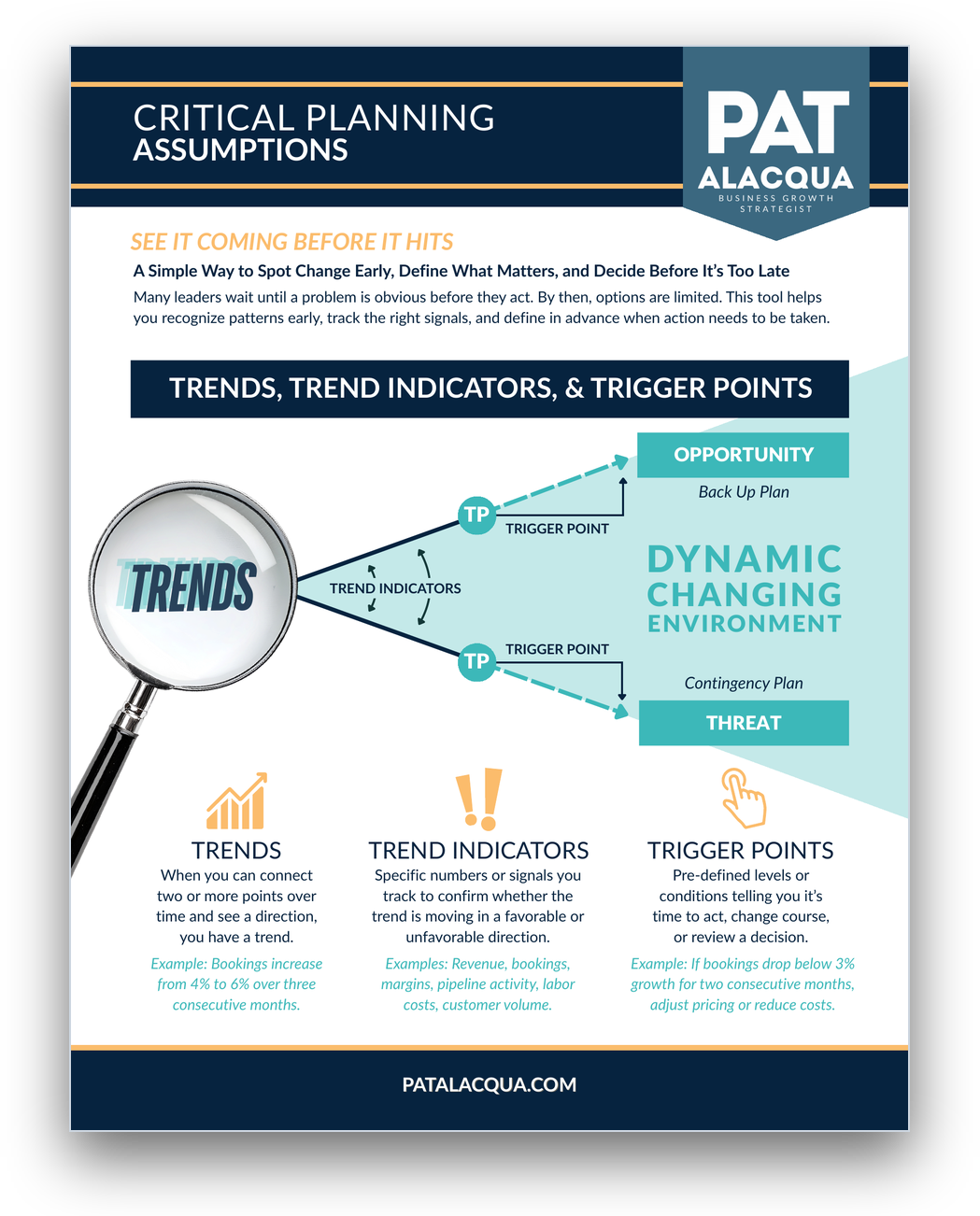
In my Windshield Planning Masterclass, you’ll uncover the things that could break your year, learn how to see them coming, and decide in advance what to do about it.
- Four video episodes, each with a companion guide
- Critical Planning Assumptions tool
- One-page framework for your monthly leadership meeting
You’re
making decisions
based on what’s already happened.
Last quarter’s financials. Last month’s pipeline review. Last week’s report. Every input you’re working from tells you where you’ve been, not where you’re going.
The customer who’s started ordering less, and nobody’s said a word. The cost line that’s been creeping while you were managing something else. The competitor who’s already positioned for the next move.
The signs were there.
You just never had a system for seeing them.
Change isn’t the problem.
Continuing to make decisions as if nothing has changed is.
You keep reviewing what already happened while conditions shift underneath you. Every quarter you’re carrying assumptions that were true when you made them. Some of them aren’t true anymore.
The longer they go unchallenged, the wider the gap between the business you think you’re running and the business you’re actually running.
Every quarter it goes unchallenged
- The customer you could have kept.
- The margin you could have protected.
- The move you could have made before someone else did.
The Four Stages of Management Focus
Where does your company sit right now?
A leader’s focus evolves through four stages. Each one has a clue. Many growth-stage companies stop at two or three.
Stage One
Your team can’t decide what matters this week without asking you first.
Stage Two
Your leadership meetings are mostly about what already happened.
Stage Three
Your team can say what they’re aiming for this quarter, but not what assumption underneath the plan would break it.
Stage Four
Your team can name what they believe to be true, they’re tracking whether it still is, and they’ve already decided what to do when it isn’t.
The move to stage four is the one many leaders never make.
What You’ll Learn
Start seeing what’s coming.
Episode 1
The Rearview Mirror
Learn why leaders get blindsided.
Discover why smart leaders still get blindsided and the four stages of management focus. From managing activities to managing planning assumptions. You’ll diagnose exactly where your company sits and see what the next move should look like.
Episode 2
The Windshield
Get the lens that changes what you see.
You’ll learn Pat’s 3D Visionary Leadership lens. A practical way to evaluate what’s happening now, what’s emerging next, and what your business needs to be ready for it.
Then you’ll begin building your Critical Planning Assumptions tool by identifying the trends that matter most and learning how to track them with evidence instead of instinct.
Episode 3
The Thermostat
Know when to act… not just what to watch for.
The Thermostat framework helps you establish clear trigger points so your team knows when changing conditions require a different decision. You’ll build a monthly Windshield Planning rhythm that keeps your team responding to what matters, when it matters… instead of reacting after the fact.
You’ll also learn the three habits that cause this discipline to break down and how to avoid them.
Episode 4
The Tool
Build the system you’ll use every month.
You’ll apply a step-by-step walkthrough of the Critical Planning Assumptions tool to your own business. Identifying the categories, assumptions, and trends that matter most. By the end of the session, you’ll have a completed planning tool and a practical framework you can bring into your next leadership meeting.
“I know your time is limited. So this is built to give you only what you need and get you back to running your business.”
What’s Included
The Windshield Planning Masterclass includes:
- Four focused video episodesGuiding you from hindsight to foresight.
- The Episode Companion GuidesOne per episode. A readable recap of the points that matter, so you can watch without taking notes.
- The Critical Planning Assumptions ToolA two-page PDF. The framework on page one. The template you fill out and bring to your next leadership meeting on page two.
- The Monthly Windshield Meeting FrameworkOne page you hand your leadership team. What each person prepares before they walk in, and the two decisions your team makes in the room.
Access at your own pace
All for $197
Get the MasterclassWho This Is For
This is built for you if:
- You’re running a growth-stage business and you can feel that your planning process isn’t keeping up with the pace of change around you.
- Your leadership meetings spend more time reviewing what already happened than deciding what to do about what’s coming.
- You want a practical system you can use in your next leadership meeting. Not general advice about being a better planner.

About Pat
Who’s behind this?
Pat Alacqua has spent decades inside growth-stage businesses, building planning and execution systems for companies navigating uncertainty. Every framework in this masterclass comes from that work, from being inside businesses like yours while they were going through it.
“Pat has the unique ability to see the finish line before you do but can help you along the way to get to that finish line.”
Bob RathbunEmmy Award-Winning NBA Broadcaster
and Business Speaker

“Pat Alacqua and his Entrepreneur to Enterprise Pathway are among the best at facilitating meaningful change. Pat is unmatched in startup operations, from conception and planning to anticipating every detail through implementation. I highly recommend him across all business types and industries.”
Dr. Bernie MullinFounder of The Aspire Group
Formerly CEO of the Atlanta Hawks, Atlanta Thrashers
and Philips Arena ·
Formerly CMO of the NBA

You can’t drive forward
by staring in the rearview mirror.
You can’t lead a growing business that way either.
Four episodes.
Access at your own pace.
$197
Meet Pat
I started a company at 24 and built it into an internationally recognized brand. When it sold, the systems already in place kept running the business. They still are, decades later. Built to last. Built to scale at every next level of growth.
I then turned around a company that was losing money with no plan to stop it. Built the management systems and built the leadership team to run the company on its own. Build the systems and build the people, and the business stops depending on one person to hold it together.
I’ve been working with CEOs and founders ever since, helping them navigate the same transitions I faced from my own companies. Different industries, different companies, same growth problems underneath. Enough to know what’s breaking and why. Usually before the leader in the middle of it can identify it.
That’s the short version.